
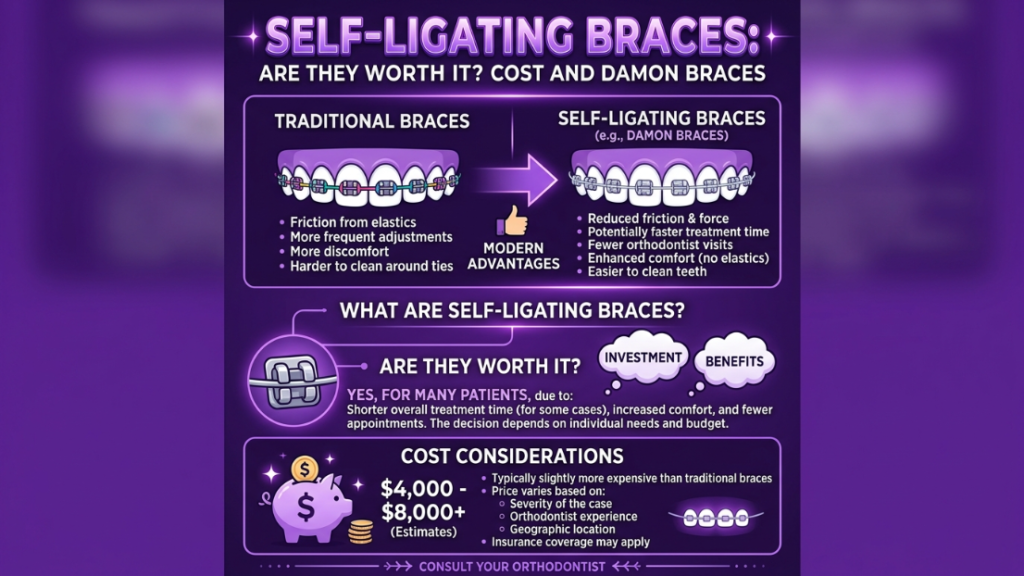
Self-ligating braces cost $4,000 to $8,000 on average in the United States. An orthodontist bonds self-ligating brackets to your teeth and threads nickel-titanium or stainless steel archwires through a built-in clip mechanism instead of rubber elastics. The setup applies steady pressure to correct malocclusion such as crowding, spacing, overbite, underbite, or crossbite over 18 to 24 months in most cases. They suit pediatric patients, adolescent patients, and adult orthodontic patients who want fewer adjustments and a slightly lower profile than traditional metal braces.
You sit in the orthodontist chair for your monthly visit and watch the doctor swap wires without replacing a single rubber band. If you compare fixed braces and wonder whether the extra cost for self-ligating braces delivers real advantages, you have company. Parents of teens, adults weighing treatment time, and anyone scanning options will get clear facts here on how self-ligating braces work, the Damon system specifically, what the “faster treatment” claims actually show, and the honest price picture in 2026. You will finish knowing if they fit your bite, budget, and lifestyle.
How Self-Ligating Braces Work
Self-ligating braces use a built-in slide or clip on each bracket that holds the archwire without rubber ligatures or elastics. The orthodontist bonds the brackets, threads the wire, and lets the low-friction mechanism do the rest.
Treatment follows the same phases as other fixed appliances. Phase 1 may start at ages 7–10 for early needs such as a palatal expander. Phase 2 covers comprehensive correction for most patients from age 11 onward. The retention phase begins once brackets come off, with a custom retainer worn full time at first then nights only.
The Damon System and Other Self-Ligating Options
The Damon system stands out as the best-known self-ligating braces. It uses passive clips that reduce friction so teeth slide along the wire more easily. Other brands offer similar self-tying braces with active or passive clips. The American Association of Orthodontists (AAO), the professional body that certifies orthodontic specialists in the US, confirms these brackets received FDA clearance for safe use in the United States.
Self-Ligating Braces Benefits and Evidence Review
Self-ligating braces promise fewer office visits and slightly shorter treatment times because the clip design cuts friction and lets wires move teeth with less force. Many orthodontists report easier cleanings and less plaque buildup since no elastics trap food.
Honest Look at “Faster Treatment” Claims
Some studies show self-ligating braces shave 2 to 4 months off total treatment compared with traditional metal braces, and patients need one fewer visit every six months. Larger reviews, however, find the difference modest and not guaranteed for every case. The AAO notes that case complexity, patient compliance, and biology still drive the timeline more than bracket type. For a 14-year-old with mild crowding, you might finish in 16 months instead of 18. For a 32-year-old with an overbite and extractions, the savings shrink.
Self-Ligating Braces Cost and Pricing Guide
Self-ligating braces cost $4,000 to $8,000 on average in the United States in 2026. They carry a modest premium over traditional metal braces because of the specialized brackets and Damon system technology.
What Drives Price Up or Down
Complex cases with tooth extractions or orthognathic surgery raise costs. Shorter treatments for minor spacing lower them. Urban areas in California or New York sit 20–25% above average; smaller Midwest cities often fall below. Check the state cost index on Brass Smile for your area.
Insurance, HSA/FSA, and Payment Options
Most dental plans limit orthodontic coverage to patients under 19 and cap benefits at a $1,000–$3,000 lifetime maximum. You can use HSA or FSA funds tax-free for the full amount.
Without full insurance, discount dental plans, orthodontic schools such as NYU or University of Michigan, and office payment plans help. Expect 20–30% down and $100–$300 monthly over 18–36 months. Many clinics offer CareCredit for interest-free financing.
Hidden Costs to Budget For
Add $150–$600 for retainers once treatment ends. Emergency visits for a broken clip run $50–$150. Replacement parts stay minimal but factor them in.
Daily Care Routine for Self-Ligating Braces
Brush after every meal with a soft toothbrush and fluoride toothpaste. A water flosser on low setting cleans under the archwire where string floss struggles—most orthodontists recommend one by the second month.
Foods to Avoid
Skip sticky items such as gum and caramel plus hard foods including nuts, popcorn, and ice. Cut firm fruits and vegetables into small pieces.
Athletic Protection
Wear a custom mouthguard that fits over the brackets during contact sports.
About BrassSmile
BrassSmile launched in 2023 after founder Alex Rivera spent two years guiding her own children through orthodontic treatment. She saw the need for honest, independent information that cuts through marketing hype and affiliate blogs.
Editorial Team
- Alex Rivera, Founder & Lead Writer (LinkedIn)
- Dr. Lisa Chen, DMD, ABO diplomate, Medical Reviewer (LinkedIn)
- Jordan Patel, DDS, Content Editor
Every article receives review by a board-certified orthodontist before publication. We update this page every six months or sooner when AAO or ADA guidelines change. We cite only peer-reviewed sources and official data from the American Dental Association (ADA), American Association of Orthodontists (AAO), and CDC dental health statistics.
Frequently Asked Questions
How much do self-ligating braces cost without insurance?
Self-ligating braces cost $4,000 to $8,000 without insurance in most US markets. You cover the full amount unless you use an in-house plan, discount program, or HSA/FSA funds.
Do self-ligating braces work faster than traditional braces?
Self-ligating braces often shave a few months off treatment and reduce visits slightly. Large studies show the difference stays modest and depends more on your specific bite than the bracket type.
What are Damon braces?
Damon braces represent the leading self-ligating system. They use passive clips instead of elastics to lower friction and allow teeth to move more freely along the wire.
Are braces without elastics easier to clean?
Braces without elastics stay cleaner because no rubber bands trap food and plaque. You still brush and floss carefully after every meal.
Can adults get self-ligating braces?
Adults get self-ligating braces daily. Healthy gums and bone let them work just as well as they do for teens.
How long do you wear self-ligating braces?
You wear self-ligating braces for 12 to 24 months on average. Minor crowding may finish in 12 months while complex cases take longer.
Do self-ligating braces hurt less?
Self-ligating braces cause the same soreness for 3 to 5 days after adjustments. Teeth feel tenderest 6 to 8 hours later regardless of bracket style.
Are self-tying braces the same as self-ligating braces?
Self-tying braces and self-ligating braces describe the same category. Both use a clip mechanism instead of rubber ligatures.
How often do you visit the orthodontist with self-ligating braces?
You visit every 6 to 8 weeks instead of every 4 weeks with traditional braces. The clip design needs fewer adjustments.
What happens after self-ligating braces come off?
You receive a custom retainer the same day. Wear it full time for the first few months, then nights only for life to keep teeth straight.