
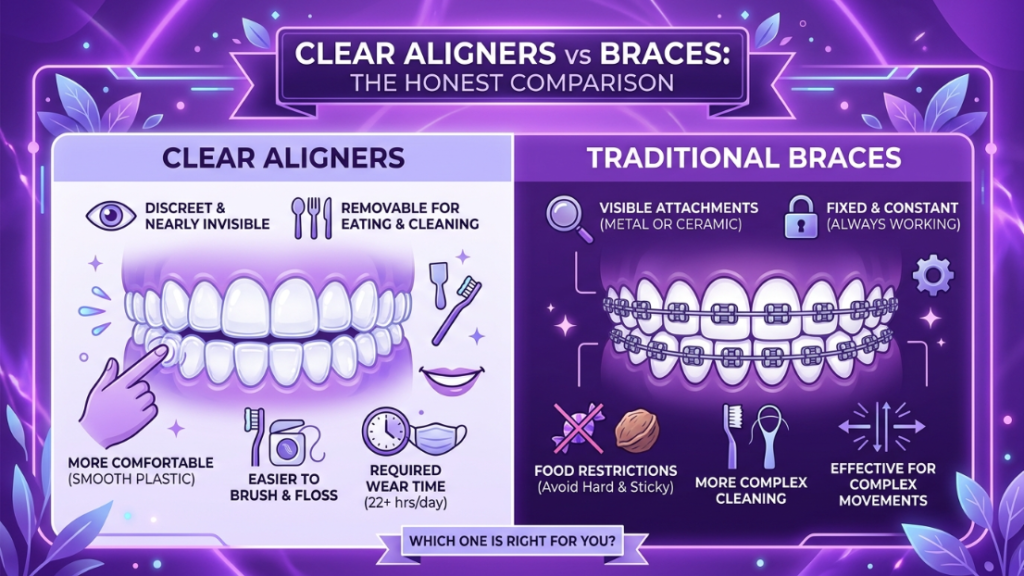
Clear aligners vs braces costs $3,000 to $8,000 for aligners and $3,000 to $13,000 for braces depending on type. Clear aligners like Invisalign or Spark use a series of custom plastic trays that you change every 1 to 2 weeks. Fixed braces use brackets and wires bonded to your teeth. Aligners work best for mild to moderate malocclusion while braces handle more complex cases better.
You scroll through before-and-after photos and wonder whether clear aligners or braces will give you the straight smile you want without turning your life upside down. Parents of teens, adults considering treatment, and people weighing Invisalign vs braces all face the same question. This guide gives you a direct, side-by-side look at clear aligners vs braces so you can make an informed decision based on your specific bite, lifestyle, and budget. You will leave knowing the real differences in cost, effectiveness, daily demands, and when one clearly beats the other.
How Clear Aligners vs Braces Work
Clear aligners and braces both move teeth by applying controlled force, but they do it in very different ways. Clear aligners use a series of removable plastic trays that gradually shift teeth into position. Fixed braces bond brackets to the teeth and use archwires to guide movement.
Both options follow similar treatment phases. The American Association of Orthodontists (AAO) recommends a first evaluation by age 7. Phase 1 early treatment can start between ages 7 and 10 for issues like narrow jaws that need expanders. Phase 2 comprehensive treatment usually begins once most permanent teeth are in. The retention phase follows with retainers you wear long-term.
Clear Aligners Process
You receive 20 to 80+ trays depending on case complexity. Each tray stays in for 1 to 2 weeks. You remove them for eating, drinking, and brushing. Invisalign and Spark aligners lead the market with digital planning that shows your expected progress.
Fixed Braces Process
Brackets stay on 24/7. The orthodontist adjusts wires every 4 to 8 weeks. This constant force works well for rotations, extrusions, and difficult bite corrections.
Clear Aligners vs Braces: Head-to-Head Comparison
Clear aligners vs braces comes down to your specific malocclusion, lifestyle, and how much discipline you have. Neither option is universally better.
Aesthetics and Visibility
Clear aligners win for nearly invisible treatment. You can take them out for important meetings or photos. Braces are more noticeable, although ceramic and lingual options reduce that drawback.
Effectiveness for Different Cases
Clear aligners handle mild crowding, spacing, and minor bite issues well. They struggle with severe rotations, large overbites, underbites, open bites, or cases needing extractions. Braces give orthodontists more control and work better for moderate to complex malocclusion. A 14-year-old with mild crowding often does great with aligners. A 29-year-old with significant overbite and several rotated teeth usually gets better results with braces.
Treatment Time
Aligners often finish in 6 to 18 months for straightforward cases. Braces average 18 to 24 months but can take longer for severe bites. The actual time depends more on biology and compliance than the appliance type.
Pain and Discomfort
Both cause pressure. Aligners tend to feel smoother day-to-day because you can remove them briefly for relief. Braces cause soreness after adjustments that peaks 6 to 8 hours later.
What Drives Price Up or Down
Case complexity raises fees the most. Longer treatment, extractions, or TADs add cost. Location matters, coastal cities run higher. Check the state cost index on BrassSmile for your area.
Insurance, HSA/FSA, and Payment Options
Most dental plans cover orthodontics up to a $1,000–$3,000 lifetime maximum, usually for patients under 19. You can use HSA or FSA funds for either option.
Without full coverage, discount dental plans, orthodontic schools like UCLA or University of Michigan, and payment plans help. Expect 20–30% down and $100–$300 monthly. CareCredit offers common financing.
Hidden Costs
Both need retainers ($150–$600). Aligners may need refinements. Braces have occasional emergency visits for broken brackets.
When Clear Aligners Win
Clear aligners vs braces shine for adults and responsible teens who want discretion and flexibility. You remove them to eat anything and brush normally. Invisalign vs braces often favors aligners when your bite needs only minor to moderate correction and you can commit to 22 hours of wear per day.
When Clear Aligners vs Braces Better Choice
Braces win for complex movements, poor compliance, or severe malocclusion. They apply constant force and give the orthodontist precise control. Cases with large overbites, multiple rotations, or the need for elastics and power chains usually do better with fixed braces.
Daily Life Aligners or Braces
Aligners require discipline. You must wear them 22 hours a day and clean them properly. Braces demand careful brushing around brackets but you never forget to “put them on.” Both have food restrictions, but braces have stricter ones.
About BrassSmile
Brass Smile launched in 2023 after founder Alex Rivera spent two years guiding her own children through orthodontic treatment. She saw the need for honest, independent information that cuts through marketing hype and affiliate blogs.
Editorial Team
- Alex Rivera, Founder & Lead Writer (LinkedIn)
- Dr. Lisa Chen, DMD, ABO diplomate, Medical Reviewer (LinkedIn)
- Jordan Patel, DDS, Content Editor
Every article receives review by a board-certified orthodontist before publication. We update this page every six months or sooner when AAO or ADA guidelines change. We cite only peer-reviewed sources and official data from the American Dental Association (ADA), American Association of Orthodontists (AAO), and CDC dental health statistics.
Frequently Asked Questions
Clear aligners vs braces which are faster?
Clear aligners finish mild cases in 6 to 18 months. Braces average 18 to 24 months but handle complex bites more efficiently in many situations.
How much do clear aligners vs braces cost without insurance?
Clear aligners cost $3,000 to $8,000 and braces range from $3,000 to $13,000 without insurance. Actual price depends on your specific case.
Is Invisalign vs braces better for adults?
Invisalign vs braces depends on your bite. Adults with mild-moderate issues often prefer aligners for the invisible look and removability.
Do clear aligners work for severe crowding?
Clear aligners work for mild to moderate crowding. Severe crowding or complex bite issues usually require braces for predictable results.
Which is more comfortable: aligners or braces?
Aligners feel more comfortable day-to-day because you can remove them. Braces cause soreness mainly after adjustments.
Can teens choose aligners or braces?
Teens can choose aligners or braces if they meet compliance and case requirements. Good candidates for aligners must wear them 22 hours daily.
How do you clear aligners or braces?
You brush aligners separately with mild soap. Braces require careful brushing around brackets and flossing with threaders or a water flosser.
Will insurance cover clear aligners or braces?
Insurance usually applies the same orthodontic lifetime maximum to both options, typically $1,000–$3,000 for patients under 19.
What happens if I don’t wear aligners enough?
Not wearing aligners 22 hours a day extends treatment or requires new trays. Braces don’t have this compliance risk.
Do I need retainers after aligners or braces?
You need retainers after both. Most patients wear them full time at first, then nights only for life.
What to Do Next
The choice between clear aligners vs braces comes down to your specific malocclusion, lifestyle, and how much structure you need during treatment. You now have the facts on cost, effectiveness, and daily realities.
Schedule a consultation with a board-certified orthodontist or ABO diplomate. Bring your questions and insurance information. Read our guide on traditional metal braces or ceramic braces next to explore fixed options further.
This article is for informational purposes only and is not a substitute for professional dental or orthodontic advice. Always consult a licensed orthodontist for guidance specific to your situation.