
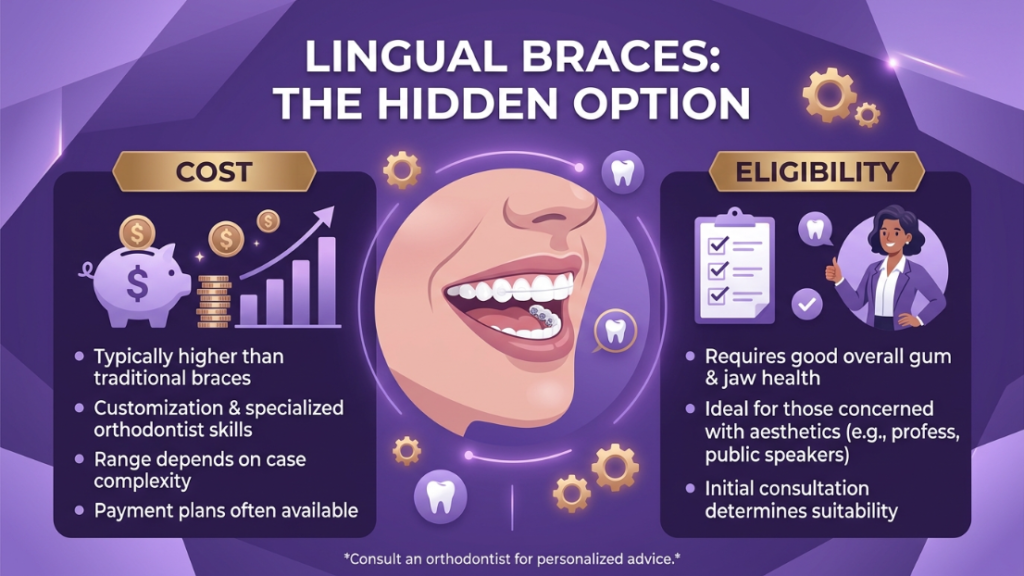
Lingual braces cost $8,000 to $13,000 on average in the United States. An orthodontist bonds custom brackets to the back surface of your teeth and threads nickel-titanium or stainless steel archwires through them. The hidden placement corrects malocclusion such as overbite, underbite, crossbite, crowding, or spacing over 18 to 36 months in most cases. They suit adult orthodontic patients who want completely invisible treatment but need fixed control that clear aligners cannot always match.
You stand in front of the mirror practicing your next big presentation and wonder if anyone will notice braces on your teeth. If you need orthodontic correction but refuse visible brackets, lingual braces give you the discreet option you want. Adults who speak in public, parents who want to stay low-key during teen treatment, or professionals comparing every fixed and removable system will get straight answers here. You will walk away knowing the customization process, real speech changes, who actually qualifies, daily care routines, and the full price picture in 2026.
How Lingual Braces Work
Lingual braces straighten teeth from the tongue side instead of the front. The orthodontist takes precise impressions or digital scans, sends them to a lab for custom brackets and wires, then bonds everything to the back of each tooth. Archwires and elastics apply the same steady pressure you see in traditional setups.
Treatment follows standard phases. Phase 1 may begin at ages 7–10 for early interceptive needs such as a palatal expander. Phase 2 covers full correction for most patients starting around age 11 or later. The retention phase starts the day brackets come off with a custom retainer you wear full time at first, then nights only.
Customization Process
Every set of lingual braces starts with a 3D scan or impression of your teeth. Labs create brackets that fit the exact contour of each tooth’s lingual surface. Top providers include Incognito lingual braces, the 3M system made from gold alloy for biocompatibility, and Harmony lingual, a fully customized digital option. Fabrication takes 4 to 6 weeks before placement.
Who Lingual Braces Suit Best
Lingual braces work best for adults with mild to moderate malocclusion who want zero visible hardware. They deliver precise control for rotations, spacing, diastema, and bite correction without compromising aesthetics.
Not everyone qualifies. Patients with very small teeth, severe crowding, or limited tongue space often cannot wear them. Young children and many teens find the tongue-side placement too bulky during growth spurts. The American Association of Orthodontists (AAO), the professional body that certifies orthodontic specialists in the US, notes that case selection matters more with lingual braces than with any other fixed system.
Speech Adjustment with Lingual Braces
You will notice a temporary lisp or change in speech for the first 1 to 2 weeks. The brackets sit against your tongue, so “s” and “th” sounds feel different until your tongue adapts. Most patients sound normal again by day 10 to 14.
Speech Therapy Tips for the First 2 Weeks
Read aloud for 10 minutes three times a day. Practice tongue twisters slowly. Chew sugar-free gum to build tongue strength. If the lisp lingers past two weeks, your orthodontist can smooth bracket edges or adjust wire shape.
Lingual Braces vs Clear Aligners
Lingual braces stay fixed 24/7 so you never forget to wear them. Clear aligners such as Invisalign or Spark let you remove trays for meals and cleaning but require 22 hours of daily wear for results.
For complex bite corrections or tooth rotations, lingual braces often finish straighter because force stays constant. A 32-year-old with an overbite and $2,000 insurance benefit may see better control with behind-the-teeth braces than with aligners alone. Adults who travel frequently sometimes prefer the set-it-and-forget-it nature of lingual braces.
Lingual Braces Cost and Pricing Guide
Lingual braces cost $8,000 to $13,000 on average in the United States in 2026. The higher price reflects custom lab fabrication, longer placement appointments, and specialized training required for orthodontists.
What Drives Price Up or Down
Severe cases with extractions or orthognathic surgery increase fees. Shorter treatments for minor spacing reduce them. Urban centers on the coasts run 25–35% above the national average. Check the state cost index on BrassSmile for your exact location.
Insurance, HSA/FSA, and Payment Options
Most dental plans cap orthodontic benefits at $1,000–$3,000 lifetime maximum and cover patients under 19 only. You can use HSA or FSA funds tax-free for the full amount.
Without full coverage, discount dental plans, orthodontic schools like NYU or University of Michigan, and in-house payment plans bridge the gap. Typical terms include 20–30% down and $100–$300 monthly over 18–36 months. Many offices partner with CareCredit for 0% interest plans.
Hidden Costs to Budget For
Add $150–$600 for a set of retainers after treatment. Emergency visits for a loose bracket cost $75–$200 because adjustments take longer on the lingual side. Replacement parts stay minimal but factor them in.
Daily Care Routine for Lingual Braces
Brush after every meal with a soft toothbrush angled toward the back of your teeth. A water flosser on low setting cleans under the archwire where string floss cannot reach—orthodontists recommend one by the second month for most patients.
Foods to Avoid
Skip hard items such as ice, nuts, and popcorn plus sticky foods like caramel and gum. Cut firm fruits and vegetables into small pieces.
Athletic Protection
Wear a custom mouthguard designed for behind-the-teeth braces during contact sports.
About BrassSmile
Brass Smile launched in 2023 after founder Alex Rivera spent two years guiding her own children through orthodontic treatment. She saw the need for honest, independent information that cuts through marketing hype and affiliate blogs.
Editorial Team
- Alex Rivera, Founder & Lead Writer (LinkedIn)
- Dr. Lisa Chen, DMD, ABO diplomate, Medical Reviewer (LinkedIn)
- Jordan Patel, DDS, Content Editor
Every article receives review by a board-certified orthodontist before publication. We update this page every six months or sooner when AAO or ADA guidelines change. We cite only peer-reviewed sources and official data from the American Dental Association (ADA), American Association of Orthodontists (AAO), and CDC dental health statistics.
Frequently Asked Questions
How much do lingual braces cost without insurance?
Lingual braces cost $8,000 to $13,000 without insurance in most US markets. You pay the full amount unless you use an in-house plan, discount program, or HSA/FSA funds.
Do lingual braces affect speech?
Lingual braces cause a temporary lisp for 1 to 2 weeks until your tongue adjusts. Most patients speak normally again by day 10 to 14 with daily practice.
Are lingual braces the same as invisible braces behind teeth?
Lingual braces and invisible braces behind teeth describe the same hidden option. Brackets sit on the tongue side so nothing shows when you smile.
Who qualifies for lingual braces?
Adults with mild to moderate malocclusion usually qualify for lingual braces. Patients with severe crowding, small teeth, or limited tongue space often do not.
How long do you wear lingualbraces?
You wear lingual braces for 18 to 36 months on average. Minor cases finish faster while complex bites take longer.
Can teens get lingual braces?
Teens can get lingual braces but many orthodontists recommend them only after permanent teeth fully erupt and growth slows.
What are the top brands of lingualbraces?
Incognito lingual braces and Harmony lingual lead the market. Both use custom digital fabrication for a precise fit.
Do lingualbraces hurt more than front braces?
Lingual braces cause the same soreness for 3 to 5 days after adjustments. Teeth feel tenderest 6 to 8 hours later regardless of placement.
How do you clean lingual braces?
Brush the back of each tooth carefully and use a water flosser daily. The tongue-side location makes cleaning slightly harder at first but you adapt quickly.
What happens after lingual braces come off?
You receive a custom retainer the same day. Wear it full time for the first few months, then nights only for life to keep teeth straight.