
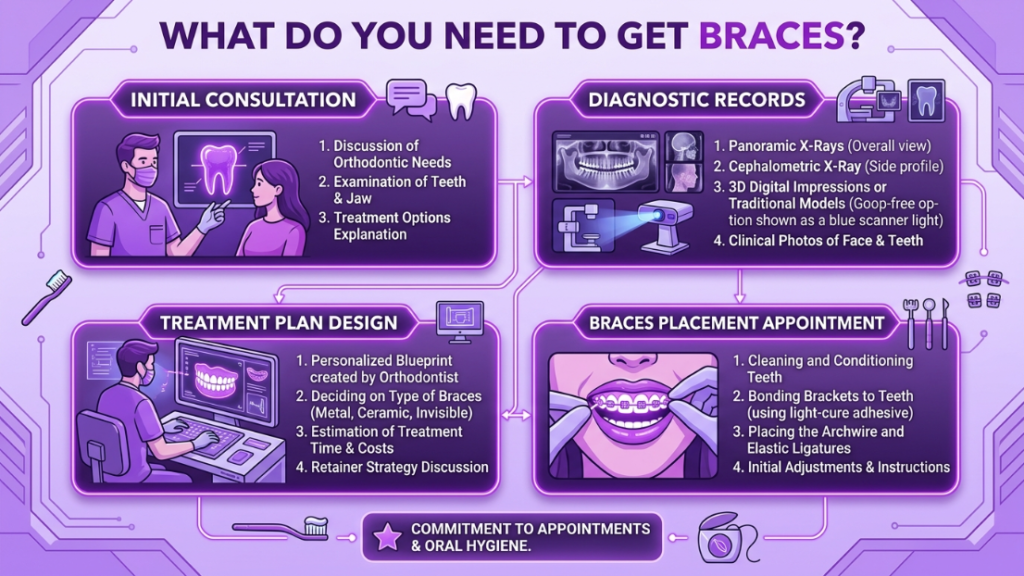
What do you need to get braces? Healthy teeth and gums with no active cavities, full records (X-rays, scans, photos), insurance details, and a solid financial plan. Most patients start with a consultation that costs $75–$300 (often credited toward treatment) and then pay $3,000 to $7,000 on average for traditional metal braces.
You schedule the first orthodontic visit and suddenly realize you have no idea what do you need to get braces. Parents booking teen treatment, adults finally fixing their bite, and anyone comparing options all ask the same practical questions. This guide gives you the complete braces consultation requirements and getting braces checklist so you walk in prepared, avoid surprises, and start treatment smoothly. You will finish knowing exactly what your orthodontist expects, how to prepare your teeth and budget, and the steps that keep the whole process on track.
Braces Consultation Requirements
The braces consultation requirements start with a healthy mouth. Your orthodontist needs no active cavities, gum disease, or untreated infections before brackets go on. A general dentist cleans and checks your teeth first—many orthodontists require a recent cleaning note.
At the visit the orthodontist takes photos, X-rays or 3D scans, and impressions or digital records. These records let them map your malocclusion and create a custom plan. Bring your dental insurance card, any prior X-rays, and a list of questions. The appointment usually lasts 45 to 90 minutes and often includes a treatment estimate on the spot.
Pre-Braces Dental Checkup Checklist
Use this simple list before your consultation:
- Schedule a cleaning and exam with your general dentist.
- Fix any cavities or fillings.
- Treat gum issues or inflammation.
- Update your medical history (allergies, medications).
- Bring insurance details and prior records.
- Ask about payment plans or financing early.
Cost Breakdown by Age Group
- Children (7–11): $3,000–$5,500. Phase 1 treatment stays shorter.
- Teens (12–17): $3,500–$6,500. Full Phase 2 treatment.
- Adults (18+): $4,000–$7,000 or higher for complex cases.
What Drives Price Up or Down
Case complexity and treatment length affect the total more than anything else. Urban areas run higher. Check the state cost index on BrassSmile for your area.
Insurance, HSA/FSA, and Payment Options
Most plans cover orthodontics up to a $1,000–$3,000 lifetime maximum, usually for patients under 19. You can use HSA or FSA funds tax-free.
Without full coverage, discount dental plans, orthodontic schools like NYU or University of Michigan, and in-house payment plans help. Expect 20–30% down and $100–$300 monthly over 18–36 months. CareCredit offers common 0% interest financing.
Hidden Costs to Budget For
Retainers cost $150–$600 after removal. Emergency visits for a broken bracket run $50–$150.
Getting Braces Checklist
Print or save this getting braces checklist so nothing slips through the cracks:
- Confirm your general dentist cleared you with no active cavities.
- Gather insurance cards and any prior X-rays.
- Review the treatment estimate and sign payment agreements.
- Stock up on soft foods, orthodontic wax, and a water flosser.
- Schedule your installation appointment.
- Plan transportation home after getting braces on (soreness can surprise you).
About BrassSmile
Brass Smile launched in 2023 after founder Alex Rivera spent two years guiding her own children through orthodontic treatment. She saw the need for honest, independent information that cuts through marketing hype and affiliate blogs.
Editorial Team
- Alex Rivera, Founder & Lead Writer (LinkedIn)
- Dr. Lisa Chen, DMD, ABO diplomate, Medical Reviewer (LinkedIn)
- Jordan Patel, DDS, Content Editor
Every article receives review by a board-certified orthodontist before publication. We update this page every six months or sooner when AAO or ADA guidelines change. We cite only peer-reviewed sources and official data from the American Dental Association (ADA), American Association of Orthodontists (AAO), and CDC dental health statistics.
Frequently Asked Questions
What do you need to get braces from your dentist first?
You need a clean bill of health from your general dentist—no active cavities or gum disease—before you can get braces.
Do I need X-rays to get braces?
Yes, you need current X-rays or 3D scans as part of the records your orthodontist takes during the consultation.
What insurance information do I need to get braces?
Bring your dental insurance card and know your plan’s lifetime orthodontic maximum, usually $1,000–$3,000.
How much money do I need to get braces?
Plan for a 20–30% down payment plus $100–$300 monthly. Total cost ranges from $3,000 to $13,000 depending on type.
Can I get braces with cavities?
No, you cannot get braces with active cavities. Your dentist must fix them first.
What records does the orthodontist need to get braces?
The orthodontist needs photos, X-rays or scans, impressions or digital models, and a full medical and dental history.
Is a pre-braces dental checkup required?
Yes, a pre-braces dental checkup is required so your teeth and gums are healthy before brackets go on.
What financial documents do I need to get braces?
You need proof of income or credit for payment plans, plus your insurance card and any discount plan details.
Can adults get braces without a referral?
Adults can get braces without a referral from a general dentist, but many orthodontists still require a recent cleaning.
What happens if I skip the consultation requirements?
Skipping the consultation requirements can delay treatment or lead to problems once braces are on.