
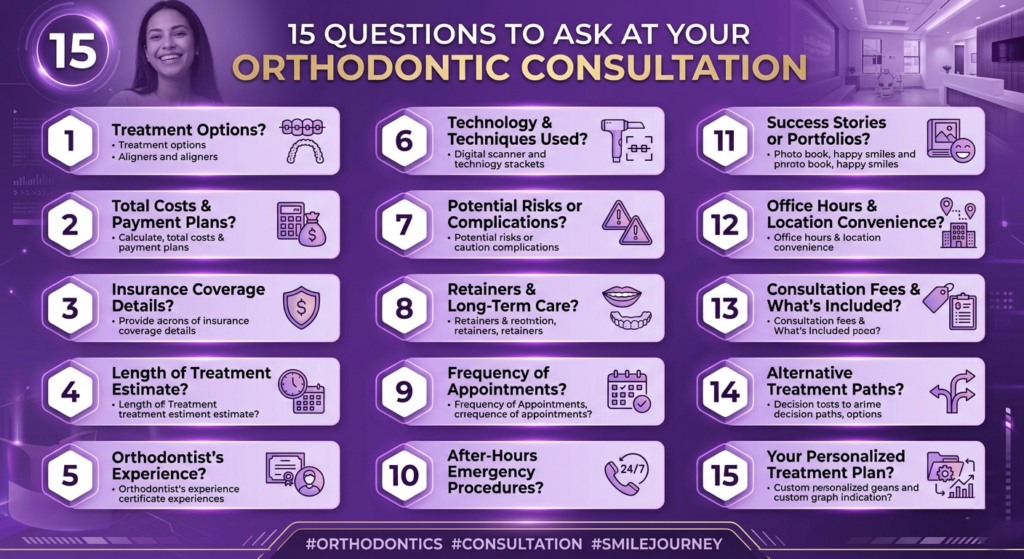
You’re sitting in the consultation room. The orthodontist just showed you a digital simulation of your future smile. It looks great. But your brain is racing: What should I actually ask before I sign anything? Here’s the short answer: The 15 questions to ask orthodontist in this guide cover treatment approach, total cost, timeline, hidden fees, emergency care, and backup coverage. Asking these questions turns a confusing sales pitch into a clear comparison between providers. Print this list. Take it to every consultation.
By the end, you’ll know exactly how to compare orthodontists and avoid surprise charges.
Question Category 1: Diagnosis & Treatment Plan
These questions establish what needs to be fixed and how.
1. What is my specific diagnosis?
Don’t accept “you have crooked teeth.” Ask for the specific orthodontic terms:
- Overbite? (upper teeth covering lower too much)
- Underbite? (lower teeth in front of upper)
- Crossbite? (some upper teeth sit inside lower)
- Open bite? (front teeth don’t touch)
- Crowding or spacing?
Why it matters: If the orthodontist can’t name your specific malocclusion, they may not have a clear treatment plan.
2. What treatment options do I have, and which do you recommend?
Barss Smile A good orthodontist offers at least three options:
- Metal braces (most affordable)
- Ceramic braces (less visible)
- Clear aligners (Invisalign, Spark)
Why it matters: If they only push one option (usually the most expensive), get a second opinion.
3. Do I need any extractions, expanders, TADs, or surgery?
Ask specifically about:
- Extractions (removing teeth to create space)
- Palatal expander (for children with narrow upper jaw)
- TADs (temporary anchorage devices, small screws for adults)
- Orthognathic surgery (jaw surgery for severe cases)
Why it matters: These add significant cost and treatment time. You need to know upfront.
4. Can you show me before-and-after photos of cases like mine?
Ask to see photos of patients with similar:
- Age (child, teen, adult)
- Diagnosis (overbite, crowding, etc.)
- Treatment type (braces or aligners)
Why it matters: Photos prove experience. No photos = no evidence.
Question Category 2: Timeline & Appointments
These questions help you understand the time commitment.
5. How long will my treatment take?
Standard answers:
- Simple cases: 12–16 months
- Average cases: 18–24 months
- Complex cases: 24–30+ months
Why it matters: If they promise 6 months for a complex case, run. That’s a marketing gimmick.
6. How often will I need adjustment appointments?
Typical frequency: every 6–10 weeks.
- Braces: usually 6–8 weeks
- Invisalign: can be 8–12 weeks (you change trays at home)
Why it matters: If you’re driving 60 minutes each way, less frequent appointments matter.
7. How long will each adjustment appointment take?
- Braces: 20–30 minutes
- Invisalign: 15–20 minutes
Why it matters: Helps you plan work and school schedules.
8. What happens if my treatment takes longer than estimated?
Ask directly: “Will I be charged for additional adjustments?”
Why it matters: Some orthodontists include unlimited adjustments. Others charge after the estimated timeframe. This can add hundreds of dollars.
Question Category 3: Total Cost & Hidden Fees
These questions prevent surprise charges.
9. What is the total all-in cost?
Ask for a written breakdown that includes:
- Initial consultation (is it free or credited?)
- Records (X-rays, photos, digital scan)
- All adjustments
- All brackets, wires, elastics, power chains
- First set of retainers
- Emergency visits (how many free?)
- Broken bracket repairs (how many free?)
Why it matters: A $4,500 quote with no emergency coverage could cost more than a $5,500 quote with everything included.
10. What is NOT included in that price?
Specifically ask about:
- Replacement retainers (after first set) – $150–$600
- Lost aligners – $100–$300 each
- Extractions – $150–$400 per tooth
- TADs – $300–$600 each
- Broken brackets after the free limit – $25–$75 each
Why it matters: These hidden costs catch most patients off guard.
11. What is your payment plan?
Ask about:
- Down payment amount (typically 20–30% of total)
- Monthly payment (typically $100–$300)
- Interest rate (should be 0% for in-house financing)
- Length of payment plan (18–36 months)
- Late payment fees
Why it matters: 0% in-house financing is standard. Don’t accept interest charges.
12. Do you accept my dental insurance? What will I actually pay?
Bring your insurance card. Ask them to:
- Verify in-network status
- Calculate your estimated out-of-pocket cost
- Explain the lifetime orthodontic maximum ($1,000–$3,000 typical)
Why it matters: Insurance verification prevents billing surprises.
Question Category 4: Backup & Emergency Care
These questions matter when something goes wrong.
13. What is your emergency care policy?
Ask about:
- Same-day emergency appointments? (for broken brackets, poking wires)
- After-hours phone number? (evenings, weekends)
- Average response time for emergencies?
Why it matters: A poking wire can cut your tongue. You need a real person, not a voicemail.
14. What happens if you retire or move during my treatment?
Ask: “Who will take over my care if you’re not available?”
Why it matters: Orthodontists retire. Practices get sold. You need a backup plan.
15. Who will actually perform my adjustments?
Ask: “Will you do the adjustments, or will a clinical assistant?”
Why it matters: Both are fine, but you should know. Some orthodontists do every adjustment. Others delegate. Ask about supervision.
Printable Checklist (Copy This)
text
15 Questions to Ask Your Orthodontist – Printable Checklist
Provider Name: ___________________
Date: ___________________
[ ] 1. What is my specific diagnosis (overbite, underbite, etc.)?
[ ] 2. What treatment options do I have?
[ ] 3. Do I need extractions, expanders, TADs, or surgery?
[ ] 4. Can you show me before-and-after photos of similar cases?
[ ] 5. How long will my treatment take?
[ ] 6. How often will I need adjustment appointments?
[ ] 7. How long will each adjustment take?
[ ] 8. What if treatment takes longer? Will I be charged?
[ ] 9. What is the total all-in cost? (Get it in writing)
[ ] 10. What is NOT included in that price?
[ ] 11. What is your payment plan? (Down payment, monthly, interest)
[ ] 12. Do you accept my insurance? What will I actually pay?
[ ] 13. What is your emergency care policy?
[ ] 14. What if you retire or move during my treatment?
[ ] 15. Who will actually perform my adjustments?
All-in total cost: $_______
Down payment: $_______
Monthly payment: $_______
Treatment length: _______ months
Additional Context: National Averages for Reference
As you ask about cost, keep these national averages in mind.
| Brace Type | National Average (USD) |
| Traditional Metal | $3,000–$7,000 |
| Ceramic (Clear) | $4,000–$8,500 |
| Lingual (behind-teeth) | $8,000–$13,000 |
| Clear Aligners (Invisalign) | $3,000–$8,000 |
Common Questions About Orthodontic Consultations
What questions should I ask an orthodontist before starting treatment?
Ask about diagnosis, treatment options, total all-in cost, hidden fees, payment plans, treatment timeline, appointment frequency, emergency care, backup plans, and who performs adjustments. Use the 15-question checklist above.
How much does an orthodontic consultation cost?
Most orthodontists offer free consultations. Some charge $75–$300 but credit that fee toward treatment if you proceed. Avoid orthodontists who charge a non-refundable consultation fee without crediting it.
How many orthodontic consultations should I get?
At least 2–3. Prices and treatment plans can vary by $2,000–$3,000 for the same case. Always compare written quotes side by side.
What should I bring to an orthodontic consultation?
Bring your dental insurance card, a list of current medications, any recent X-rays (if available), and this 15-question checklist. Also bring a notebook to write down answers.
Can I get braces the same day as my consultation?
Rarely. Most orthodontists schedule a separate placement appointment 2–4 weeks after the consultation. This allows time for insurance verification, payment plan setup, and lab fabrication of models or aligners.
What does “all-in cost” mean for braces?
All-in cost includes everything: consultation, records, all adjustments, all hardware (brackets, wires, elastics), first set of retainers, and a set number of emergency visits and bracket repairs. Always ask for a written all-in quote.
How do I compare two orthodontist quotes side by side?
Compare total all-in cost, what’s included, what’s extra, down payment amount, monthly payment, interest rate (should be 0%), treatment time estimate, and overage policy (if treatment takes longer). Use the checklist above.
Should I see an orthodontist or a dentist for a consultation?
Always see an orthodontist (AAO member) for a consultation. General dentists can offer braces but have no formal orthodontic residency training. An orthodontist will give you a more accurate diagnosis and treatment plan.
What’s a red flag during an orthodontic consultation?
Red flags include: no before-and-after photos, vague answers about cost (“it depends”), pushing only the most expensive option, no written quote, no emergency care policy, and pressure to sign a contract today.
How long does an orthodontic consultation take?
30–60 minutes. Includes exam, X-rays (sometimes), digital scan or impressions, discussion of treatment options, and cost estimate. Leave with a written quote.
Your Next Move: Print and Go
You now have 15 essential questions to ask orthodontist before committing to treatment. Print the checklist. Take it to every consultation. Compare written quotes side by side. Choose the orthodontist who gives clear, complete answers—not the one with the flashiest office.
Download the printable PDF checklist.
For more guidance, read:
- How to Choose a Qualified Orthodontist (AAO & ABO Credentials Explained)
- How Much Do Braces Cost? (2026 National Average)
Medical Disclaimer: This article is for informational purposes only and is not a substitute for professional dental or orthodontic advice. Always consult a licensed orthodontist for guidance specific to your situation.