
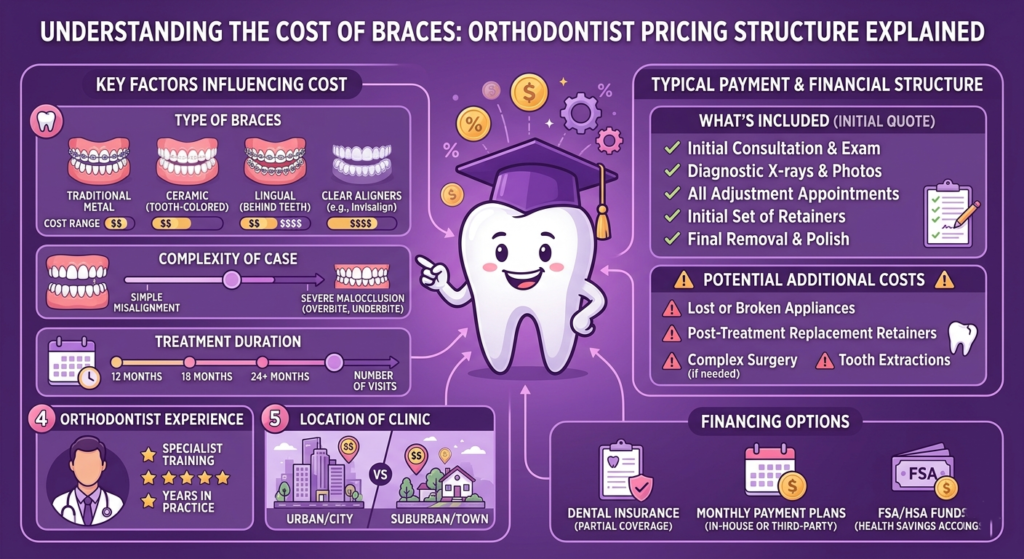
You just got a quote for braces: $5,800. But does that include retainers? What about broken brackets? Is that the final number or will there be surprises? Here’s the short answer: Most orthodontists charge a flat fee that covers the entire treatment—but not all flat fees are equal. Some include everything (retainers, emergency visits, replacement brackets). Others charge extra for retainers, lost aligners, and broken bracket repairs beyond a set number. A typical orthodontist braces cost ranges from $3,000 to $8,000 depending on type and location, with metal braces averaging $3,000–$7,000 nationally. This guide breaks down flat-fee vs. itemized billing, annotates a real sample quote, and lists exactly what should be included.
By the end, you’ll know how to compare quotes and avoid paying for hidden costs.
Flat-Fee vs. Itemized Billing: Two Different Models
Barss Smile Orthodontists use one of two pricing structures.
Flat-Fee Model (Most Common)
You pay one comprehensive fee for the entire treatment. Monthly payments spread over 18–24 months.
Typically includes:
- Initial consultation and records (X-rays, photos, scans)
- All adjustments (every 6–10 weeks)
- All brackets, wires, elastics, power chains
- Retainers (first set)
- A set number of emergency visits (often 2–4 free)
- Replacement of broken brackets (often 2–4 free)
Best for: Patients who want predictability and fewer surprise charges.
Itemized Billing (Less Common)
You pay separately for each component: consultation, records, placement, each adjustment, retainers, broken brackets, etc.
Typically looks like:
- Consultation: $150
- Records (X-rays, photos, scans): $300
- Placement appointment: $1,000
- Each adjustment: $75–150 × 12–18 adjustments
- Retainers: $300
- Broken bracket repair (each): $50
Best for: Patients with very simple cases who understand exactly what they need. Almost never cheaper in the long run.
Which Model Should You Prefer?
Flat-fee with clear inclusions. It protects you from cost creep. If treatment takes longer than expected (it often does), you don’t pay extra. If you break a bracket (you will), you’re covered.
What Should Be Included in Your Flat Fee?
Ask every orthodontist for a written breakdown. Here’s what “comprehensive” should mean.
Must-Be-Included (Non-Negotiable)
| Item | Typical Cost if Extra | Should Be Included? |
| Initial consultation | $75–$300 | Yes (or credited toward treatment) |
| Records (X-rays, photos, scans) | $200–$500 | Yes |
| All adjustments (12–24 visits) | $75–$150 each | Yes |
| All brackets, wires, elastics, power chains | $500–$1,500 | Yes |
| Retainers (first set) | $150–$600 | Yes |
| Emergency visits (at least 2–4) | $25–$75 each | Yes |
| Broken bracket repair (at least 2–4) | $25–$75 each | Yes |
Nice-to-Have Included (Not Universal)
| Item | Typical Cost if Extra | Ask About It |
| Lost aligner replacement (Invisalign) | $100–$300 each | Often extra |
| Replacement retainers (after first set) | $150–$600 | Almost always extra |
| Extractions | $150–$400 per tooth | Usually extra |
| TADs (temporary anchorage devices) | $300–$600 each | Usually extra |
Red Flags in a Quote
- “Consultation fee applies toward treatment” – Acceptable only if they charge it upfront. Most are free.
- “Adjustments after 24 months will be billed separately” – Treatment estimates are just estimates. This punishes you if treatment takes longer.
- “Broken brackets $50 each after the first” – Reasonable only if they give you 2–4 free repairs first.
- No written breakdown at all – Walk away.
Sample Quote Annotated
Here’s a real (anonymized) orthodontist quote with annotations showing what’s good and what’s missing.
Sample Quote – Orthodontist A
| Item | Amount | Notes |
| Comprehensive metal braces | $5,200 | Covers all brackets, wires, adjustments (estimated 22 months) |
| Records fee | $0 | Included in comprehensive fee |
| Retainers (first set) | $0 | Included in comprehensive fee |
| Emergency visits (first 2) | $0 | Additional emergency visits: $50 each |
| Broken bracket repair (first 2) | $0 | Additional broken brackets: $50 each |
| Invisalign alternative | $6,200 | Includes 2 sets of Vivera retainers |
| Down payment (due at placement) | $1,300 | 25% of $5,200 |
| Monthly payment (24 months) | $162.50 | 0% interest |
| Total | $5,200 |
What’s good: Flat-fee includes records and first retainers. Down payment is reasonable 25%. 0% interest monthly payments. Clear about emergency and broken bracket limits.
What’s missing: Does not specify what happens if treatment exceeds 22 months. Ask! Also unclear if replacement aligners (if Invisalign) are included (probably not).
Our verdict: Solid quote. Ask for written clarification on treatment overage and lost aligners. 4/5 stars.
Sample Quote Annotated – Orthodontist B (Problematic)
| Item | Amount | Notes |
| Metal braces (18 months) | $4,500 | Includes brackets and wires only |
| Records (X-rays, photos, scans) | $350 | Separate charge |
| Placement appointment fee | $250 | Separate charge |
| Monthly adjustment fee (estimated 16 visits) | $75 each | $1,200 total |
| Retainers | $300 | Separate charge |
| Consultation | $150 | Not credited toward treatment |
| Total | $6,750 |
What’s bad: Itemized billing makes the total ($6,750) higher than most flat-fee quotes. No included emergency visits or broken bracket repairs. Consultation not applied to treatment. No payment plan mentioned.
Our verdict: Avoid. This orthodontist is nickel-and-diming. 1/5 stars.
Hidden Costs Most Patients Miss
Even with a good flat-fee quote, watch for these.
1. Retainers After the First Set
Your first set is usually included. But you’ll need replacements every 5–10 years (Hawley) or 2–5 years (Essix). Each replacement costs $150–$600.
Ask: “What do replacement retainers cost at your office?”
2. Lost Aligners (Invisalign)
If you lose an aligner, your orthodontist may charge $100–$300 to remake it. Some include 1–2 free replacements. Most do not.
Ask: “What’s your policy on lost aligners?”
3. Broken Brackets After the Free Limit
Most orthodontists include 2–4 free bracket repairs. After that, $25–$75 each. Teenagers often exceed this limit. Adults rarely do.
Ask: “How many free bracket repairs are included? What’s the cost after that?”
4. Extended Treatment Time
Your quote says 22 months. But if your teeth move slowly, you might need 28 months. Some orthodontists charge for adjustments after the estimated timeframe.
Ask: “What happens if treatment takes longer than estimated? Are adjustments still included?”
5. Extractions
If you need teeth removed to make space for braces, extractions are almost never included in the orthodontic fee. General dentists or oral surgeons charge $150–$400 per tooth.
Ask: “Does your quote include extractions if needed?”
How to Compare Quotes from Multiple Orthodontists
Use this table to compare apples to apples.
| Question | Orthodontist A | Orthodontist B | Orthodontist C |
| Flat fee or itemized? | |||
| Total cost (metal braces) | |||
| Includes retainers? | |||
| Includes emergency visits? | |||
| Includes broken bracket repairs? | |||
| Down payment amount | |||
| Monthly payment (24 months) | |||
| What’s extra? | |||
| Treatment time estimate | |||
| Overage policy (if longer) |
Typical Orthodontist Braces Cost by Type and Age
Here’s what to expect for the all-in flat fee.
| Brace Type | National Average (USD) |
| Traditional Metal | $3,000–$7,000 |
| Ceramic (Clear) | $4,000–$8,500 |
| Lingual (behind-teeth) | $8,000–$13,000 |
| Self-Ligating (Damon) | $4,000–$8,000 |
| Clear Aligners (Invisalign, Spark) | $3,000–$8,000 |
Cost by Age Group
| Age Group | Average Cost (Metal Braces) |
| Child (Phase 1, 7–11) | $3,000–$5,500 |
| Teen (Phase 2, 12–17) | $3,500–$6,500 |
| Adult (18+) | $4,000–$7,000 |
Insurance and Payment Plans
Typical dental insurance: $1,000–$3,000 lifetime orthodontic maximum. Covers 50% of the flat fee after deductible, usually for dependents under 18 only.
HSA/FSA: Yes, you can use both for down payments and monthly payments.
In-house financing: Most orthodontists offer 0% interest with 20–30% down ($600–$2,100 depending on total), then $100–$300/month for 18–36 months.
CareCredit: Medical credit card. Deferred interest options (6–18 months). Works at most orthodontists.
Frequently Asked Questions
How much does orthodontist braces cost on average?
Metal braces cost $3,000–$7,000 on average. Ceramic: $4,000–$8,500. Invisalign: $3,000–$8,000. Lingual: $8,000–$13,000. Prices vary by location (coastal cities are 10–30% higher) and case complexity.
What’s included in the orthodontist braces cost?
Most flat-fee quotes include consultation, records (X-rays, photos, scans), all adjustments, all brackets and wires, first set of retainers, and 2–4 emergency visits and bracket repairs. Always ask for a written breakdown.
Are retainers included in the cost of braces?
Usually yes for your first set. Replacement retainers (when they wear out) cost $150–$600 per set. Some orthodontists charge extra for retainers even the first time—ask before signing.
Why do orthodontists charge different prices?
Case complexity (severe overbite costs more than mild crowding), treatment length (36 months vs 18 months), location (NYC vs rural), orthodontist experience (board-certified costs more), and brand (Damon, Incognito add $500–$2,000).
How much is a down payment for braces?
20–30% of total cost. For $5,500 braces, down payment is $1,100–$1,650. Some orthodontists offer $0 down with CareCredit or in-house financing. Lower down payments mean higher monthly payments.
What’s the monthly payment for braces?
$100–$300 per month for 18–36 months with 0% in-house financing. Example: $5,500 braces with $1,375 down (25%) leaves $4,125 over 24 months = $171.88/month.
Does insurance cover orthodontist braces cost?
Most PPO plans cover 50% up to a $1,000–$3,000 lifetime maximum for dependents under 18. Adult coverage is rare. Medicaid covers children with qualifying conditions in most states.
What’s usually NOT included in the orthodontist braces cost?
Extractions ($150–$400 per tooth), lost aligners ($100–$300 each), replacement retainers after first set ($150–$600), TADs ($300–$600 each), and broken brackets beyond the free limit ($25–$75 each).
Can I use my HSA for orthodontist braces cost?
Yes. Braces are a qualified medical expense. HSA funds (up to $3,850 individual / $7,750 family in 2026) and FSA funds ($3,200) can be used for down payments, monthly payments, retainers, and emergency repairs.
How do I compare quotes from different orthodontists?
Ask each for a written breakdown of total cost, what’s included, what’s extra, down payment amount, monthly payment, treatment time estimate, and overage policy (if treatment takes longer than estimated). Use the comparison table in this guide.
Your Next Move: Get a Written Quote
You now understand exactly how orthodontist braces cost is structured—flat-fee vs. itemized, what should be included, and what’s usually extra. Your next step is simple: book 2–3 free consultations. Get a written quote from each. Compare them using the table above. Choose the orthodontist with the most comprehensive flat fee, not the lowest upfront number.
For more cost guidance, read:
- How Much Do Braces Cost? (2026 National Average)
- Hidden Costs of Braces: Retainers, Emergencies, Replacements
Medical Disclaimer: This article is for informational purposes only and is not a substitute for professional dental or orthodontic advice. Always consult a licensed orthodontist for guidance specific to your situation. Prices vary by provider, region, and case complexity. Data current as of 2026.