
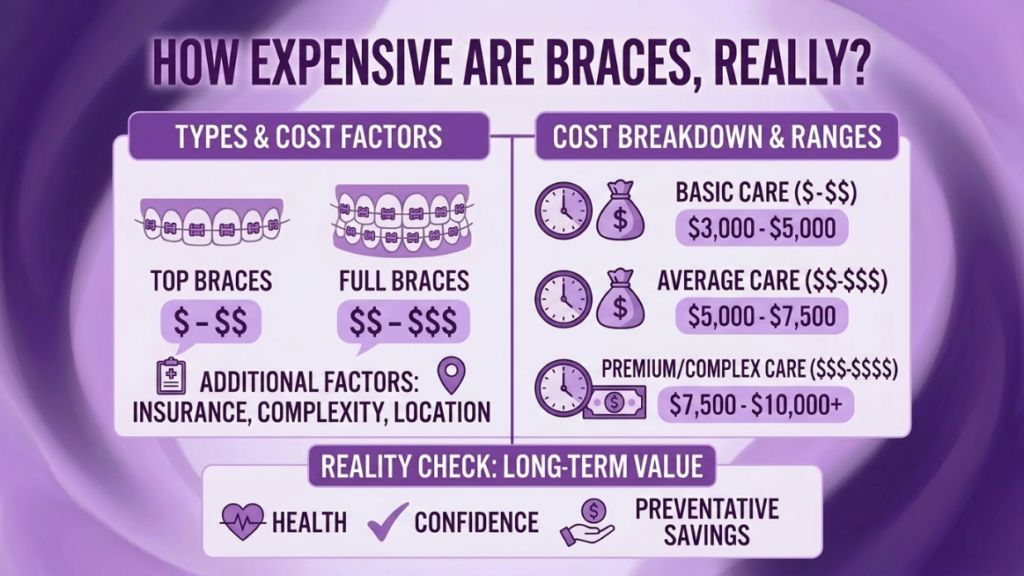
You sit across from the orthodontist holding the treatment plan and the number at the bottom makes you pause. Like most parents and adults, you immediately ask yourself: how expensive are braces?
In 2026, how expensive are braces really depends on the type, but the national average for traditional metal braces sits between $3,000 and $7,000. Ceramic, self-ligating, lingual, and clear aligner options cost more. This page explains exactly why the price is what it is, whether braces deliver enough value to justify the cost, the long-term dental health and confidence benefits, and realistic lower-cost alternatives so you can decide what makes sense for your family.
You will walk away with clear numbers, honest tradeoffs, and practical next steps.
Full Price Comparison of Braces Types in 2026
The appliance you choose changes how expensive are braces for your specific case.
| Brace Type | Price Range (2026) | Typical Treatment Time | Best For | Main Drawback |
| Traditional Metal Braces | $3,000 – $7,000 | 18–24 months | Most cases, including complex | Most visible |
| Ceramic Braces | $4,000 – $8,500 | 18–24 months | Less noticeable brackets | Brackets can stain |
| Self-Ligating Braces (Damon system) | $4,000 – $8,000 | 12–20 months | Fewer office visits | Slightly higher upfront cost |
| Lingual Braces | $8,000 – $13,000 | 18–36 months | Completely hidden braces | Temporary speech changes |
| Clear Aligners (Invisalign, Spark) | $3,000 – $8,000 | 6–18 months | Mild to moderate crowding | Not ideal for severe bite issues |
Traditional metal braces remain the least expensive option for most patients.
How Expensive Are Braces by Age Group
Children (ages 7–11)
Phase 1 early treatment keeps the cost lower, usually $2,000–$4,500. Many offices credit this amount toward Phase 2, so the overall total stays manageable.
Teens (ages 12–17)
Full comprehensive treatment runs $3,000–$7,000 for metal braces. This age group sees the most insurance coverage when it is available.
Adults (age 18+)
Adult treatment often lands at the higher end ($4,500–$9,000 or more) because teeth move more slowly after growth stops and many adults choose aesthetic options.
Why Braces Cost What They Do
An orthodontist completes 2–3 years of specialty training after dental school before treating patients. That extra residency is required by the American Board of Orthodontics and the American Association of Orthodontists. The office also invests in digital scanners, 3D printers for custom appliances, and ongoing staff training.
Treatment lasts 18–36 months with regular adjustments, monitoring, and problem-solving along the way. The fee covers all of that multi-year care, not just the brackets. The American Dental Association notes that orthodontic care involves far more than a one-time procedure, it is a long-term commitment to changing your bite and occlusion.
What Drives the Price Up or Down
Several concrete factors decide exactly how expensive are braces in your case:
- Case complexity, mild crowding finishes faster and cheaper than severe overbite requiring extractions or TADs.
- Treatment length, every extra month adds roughly $150–$250 in adjustments.
- Location, coastal cities run 20–40% higher than the national average.
For the most current local numbers, check our state guides: braces cost in California, braces cost in Texas, braces cost in New York, and every other state page on Brass Smile.
Insurance, HSA/FSA, and the Real Amount You Pay
Most dental plans list a lifetime orthodontic maximum of $1,000–$3,000 and cover dependents under 18 only. You can use HSA or FSA funds tax-free for any qualified orthodontic expense, which can reduce your out-of-pocket cost by 20–30%.
Paying Without Insurance or With Limited Coverage
Most offices require a 20–30% down payment then charge $100–$300 per month over 18–36 months. Discount dental plans cut 20–40% at participating clinics. Orthodontic residency programs at NYU, UCLA, or the University of Michigan offer supervised treatment for 30–50% less.
Hidden Costs That Add Up
Budget an extra 10–15% for:
- Retainers ($150–$600 per set, needed nightly for life)
- Emergency visits for a broken bracket ($50–$300 each)
- Replacement parts ($100–$400)
- Custom sports mouthguards for kids ($150–$400)
Are Braces Worth It? The Long-Term ROI
Beyond the upfront price, braces prevent more expensive problems later. Untreated malocclusion can lead to uneven wear, jaw pain, gum disease, and extractions or implants that cost thousands more. Studies referenced by the American Association of Orthodontists also link straight teeth to higher self-esteem and better social outcomes, especially for teens.
For most patients the investment pays off in both dental health and confidence.
Frequently Asked Questions About How Expensive Are Braces
How expensive are braces for a typical case?
How expensive are braces really averages $3,000 to $7,000 for traditional metal braces in 2026. Ceramic and aligners cost more.
Why are braces so expensive compared to other dental work?
Braces require years of specialist training, ongoing adjustments, and multi-year monitoring, far more than a one-time filling or crown.
Are braces worth it for adults?
Yes for many adults. Straight teeth improve bite function, reduce future dental costs, and boost confidence even later in life.
What makes braces less expensive?
Choosing traditional metal braces, using dental school programs, discount plans, or paying with HSA/FSA funds can lower the total significantly.
How much do braces cost monthly?
After a 20–30% down payment, monthly payments usually run $100–$300 over 18–36 months.
Do braces cause long-term problems that add cost later?
No. Properly completed orthodontic treatment prevents more expensive issues like uneven wear or gum disease.
Are there cheaper alternatives to braces?
Clear aligners can be similar in price for mild cases, while dental school programs or charity options cut costs by 30–50%.
How expensive are braces with limited insurance?
Even with a $1,000–$3,000 lifetime maximum, most families still pay $0–$4,000 out of pocket depending on the plan.