
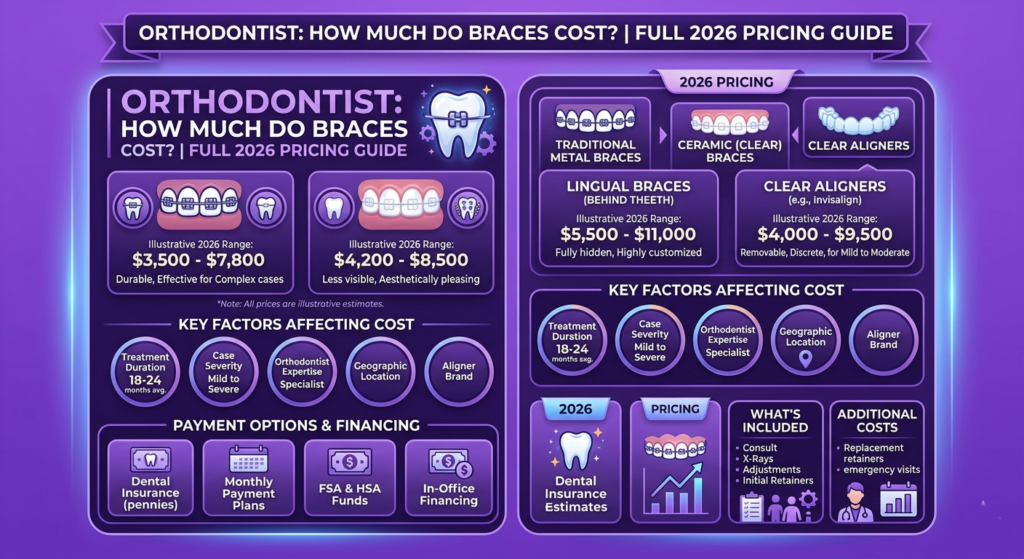
You’re sitting in an orthodontist’s chair. They just said you need braces. Now your brain is screaming one question: Orthodontist how much do braces cost? Here’s the straight answer: For traditional metal braces, you’ll pay $3,000–$7,000 nationally. Ceramic braces cost $4,000–$8,500. Invisalign runs $3,000–$8,000. Lingual (behind-the-teeth) braces cost $8,000–$13,000. But the number on your treatment plan is just the start. What’s included? What’s extra? And how much will you actually pay per month? This guide answers exactly what an orthodontist will charge you—no fluff, no surprises.
By the end, you’ll know the real cost, the hidden fees, and how to budget.
What an Orthodontist Actually Charges: The National Averages
These are the all-in flat fees most orthodontists quote. But read the fine print.
| Brace Type | National Average (USD) | What’s Usually Included |
| Traditional Metal | $3,000–$7,000 | Brackets, wires, adjustments, first retainers |
| Ceramic (Clear) | $4,000–$8,500 | Same as metal but tooth-colored brackets |
| Lingual (Incognito, Harmony) | $8,000–$13,000 | Hidden behind teeth; higher lab fees |
| Self-Ligating (Damon) | $4,000–$8,000 | Special brackets; fewer elastic changes |
| Clear Aligners (Invisalign, Spark) | $3,000–$8,000 | Removable plastic trays; more frequent changes |
Cost by Age Group
Your age matters because treatment complexity and length vary.
| Age Group | Typical Age | Average Cost (Metal Braces) | Why the Difference |
| Child (Phase 1) | 7–11 | $3,000–$5,500 | Limited treatment; guides jaw growth |
| Teen (Phase 2) | 12–17 | $3,500–$6,500 | Full comprehensive treatment |
| Adult | 18+ | $4,000–$7,000 | Adult bone is denser; may need TADs or pre-surgical work |
What Drives Your Orthodontist’s Price Up or Down
Barss Smile Not all patients pay the same. Here’s why.
Factors That Increase Cost
- Complex malocclusion (severe overbite, impacted canines): adds $1,000–$3,000
- Long treatment time (30+ months vs. 18 months): more adjustments = higher fee
- Location (Manhattan vs. rural Iowa): coastal cities are 10–30% higher
- Orthodontist vs. general dentist: specialists cost more but have 2–3 extra years of training
- Branded systems (Damon, Iomencognito): add $500–$2,000
- TADs (temporary anchorage devices) : $300–$600 each
Factors That Decrease Cost
- Orthodontic schools (NYU, UCLA, University of Michigan): 30–50% less
- Discount dental plans (Careington, DentalPlans.com): 15–25% off
- Paying in full upfront: 5–10% discount
- Choosing metal over ceramic: saves $1,000–$1,500
What Your Orthodontist’s Quote Should Include
Never sign a treatment plan that isn’t itemized. Here’s what to look for.
Must Be Included (Non-Negotiable)
| Item | Typical Standalone Cost |
| Initial consultation (often free) | $75–$300 |
| Records (X-rays, photos, digital scan) | $200–$500 |
| All adjustments (12–24 visits) | $75–$150 each |
| All brackets, wires, elastics, power chains | $500–$1,500 |
| First set of retainers | $150–$600 |
| At least 2–4 emergency visits | $25–$75 each |
| At least 2–4 broken bracket repairs | $25–$75 each |
Usually Extra (Ask Before Signing)
| Item | Typical Cost |
| Replacement retainers (after first set) | $150–$600 |
| Lost aligner replacement (Invisalign) | $100–$300 each |
| Extractions | $150–$400 per tooth |
| TADs (temporary anchorage devices) | $300–$600 each |
| Treatment overage (if longer than estimated) | Varies |
The Hidden Costs Most Patients Miss
Your orthodontist gave you a quote. But these surprise charges catch many people off guard.
1. Consultation Fee Not Credited
Some orthodontists charge $100–$300 for the initial exam and don’t apply it to treatment. Avoid these offices. Most offer free consultations.
2. Retainers After the First Set
Your first set is included. But you’ll need replacements every 5–10 years (Hawley) or 2–5 years (Essix). Each set costs $150–$600.
3. Broken Brackets After the Free Limit
Most orthodontists include 2–4 free bracket repairs. After that, $25–$75 each. Teenage athletes often exceed the limit. Adults rarely do.
4. Lost Aligners
If you lose an Invisalign tray, replacement costs $100–$300. Some orthodontists include 1–2 free replacements. Most do not.
5. Extended Treatment Time
Your quote says 22 months. But if your teeth move slowly and you need 28 months, some orthodontists charge for adjustments beyond the estimate. Ask about their overage policy.
6. Extractions
If you need teeth removed to create space, your general dentist or oral surgeon charges $150–$400 per tooth. This is almost never included in the orthodontic fee.
How Insurance Affects What Your Orthodontist Charges
Most dental plans cover orthodontics only for dependents under 18. Adult coverage is rare.
Typical Dental Plan Benefits
| Plan Type | Lifetime Orthodontic Max | Age Limit | Typical Premium |
| PPO (employer-sponsored) | $1,000–$3,000 | Under 18 only | $30–$60/month |
| PPO (adult add-on) | $1,000–$2,000 | Any age (rare) | $50–$80/month |
| HMO (low-cost) | $1,000–$1,500 | Under 18 only | $15–$30/month |
| Discount dental plan | 15–25% off fees | Any age | $100–$150/year |
HSA and FSA
Yes, you can use HSA and FSA funds for braces. A family can contribute up to $7,750 to an HSA in 2026 (individual $3,850). FSAs have lower limits ($3,200). This is pre-tax money—effectively a 20–40% discount.
Without Insurance: Payment Plans from Your Orthodontist
Most orthodontists offer in-house 0% financing. Here’s what it looks like.
Typical Payment Structure
- Down payment: 20–30% of total cost ($600–$2,100 depending on total)
- Monthly payments: $100–$300 for 18–36 months
- Interest: 0% (in-house plans)
- Credit check: Usually not required
Example Payment Scenarios
| Total Cost | Down Payment (25%) | Remaining | Monthly (24 months) |
| $4,500 | $1,125 | $3,375 | $140.63 |
| $5,500 | $1,375 | $4,125 | $171.88 |
| $6,500 | $1,625 | $4,875 | $203.13 |
| $7,500 | $1,875 | $5,625 | $234.38 |
CareCredit
Medical credit card accepted by most orthodontists. Deferred interest options (6, 12, 18 months). Pay in full within the promotional period to avoid retroactive interest.
How to Save on Your Orthodontist’s Fee
Option 1: Orthodontic Schools (30–50% less)
Treatment by residents under faculty supervision. Longer appointments but huge savings.
| School | Location | Metal Braces Cost |
| UCLA, USC | Los Angeles | $3,000–$5,000 |
| University of the Pacific | San Francisco | $3,500–$5,500 |
| University of Michigan | Ann Arbor | $2,500–$4,500 |
| UNC Chapel Hill | Chapel Hill | $2,500–$4,500 |
| NYU, Columbia | New York | $2,500–$5,000 |
Option 2: Discount Dental Plans (15–25% off)
Pay $100–$150 annually for 15–25% off orthodontic fees at participating offices. Careington and DentalPlans.com are popular.
Option 3: Paying in Full Upfront (5–10% off)
Many orthodontists offer a discount if you pay the entire flat fee at the start of treatment. Ask.
State Cost Index
Orthodontic fees vary significantly by state. Higher costs in the Northeast, California, and major metro areas. Lower costs in the Midwest and South.
BrassSmile maintains individual state cost guides. See the full list of states.
Common Questions About Orthodontist Braces Cost
How much does an orthodontist charge for braces?
Metal braces cost $3,000–$7,000. Ceramic: $4,000–$8,500. Invisalign: $3,000–$8,000. Lingual: $8,000–$13,000. These are national averages. Your price depends on case complexity, location, and whether the orthodontist is board-certified.
Does the orthodontist cost include retainers?
Usually yes for your first set. Replacement retainers (when they wear out) cost $150–$600 per set. Always ask for written confirmation that first retainers are included in the flat fee.
What’s the down payment for braces from an orthodontist?
20–30% of total cost. For $5,500 braces, down payment is $1,100–$1,650. Some orthodontists offer $0 down with CareCredit. Lower down payments spread the cost over longer terms.
How much are monthly payments for braces?
$100–$300 per month for 18–36 months with 0% in-house financing. Example: $5,500 braces with $1,375 down (25%) leaves $4,125 over 24 months = $171.88/month.
Does insurance cover orthodontist braces cost?
Most PPO plans cover 50% up to a $1,000–$3,000 lifetime maximum for dependents under 18. Adult coverage is rare. Medicaid covers children with qualifying conditions in most states.
Can I use my HSA for orthodontist braces cost?
Yes. Braces are a qualified medical expense. HSA funds (up to $3,850 individual / $7,750 family in 2026) and FSA funds ($3,200) can be used for down payments, monthly payments, retainers, and emergency repairs.
Why do orthodontists have different prices for the same braces?
Case complexity (severe malocclusion costs more), treatment length (36 months vs 18 months), location (coastal cities are 20–30% higher), orthodontist experience (board-certified costs more), and brand (Damon, Incognito add $500–$2,000).
Are orthodontic schools cheaper than private orthodontists?
Yes, 30–50% less. Metal braces at schools cost $2,500–$5,000 vs. $3,000–$7,000 at private practices. You trade time for savings—appointments are longer (2–3 hours), but faculty supervision is excellent.
What’s the cheapest type of braces from an orthodontist?
Traditional metal braces are the least expensive, $3,000–$7,000. Clear aligners (Invisalign) can be similar or slightly more for complex cases. Lingual braces are the most expensive at $8,000–$13,000.
How do I compare quotes from different orthodontists?
Ask each for a written breakdown of total cost, what’s included (retainers, emergency visits, broken bracket repairs), what’s extra, down payment, monthly payment, treatment estimate, and overage policy (if treatment takes longer than estimated).
Your Next Move: Book Free Consultations
You now know exactly what to ask when you wonder orthodontist how much do braces cost. Your next step is simple: book 2–3 free consultations with AAO orthodontists. Get a written quote from each. Compare not just the total number, but what’s included. Choose the orthodontist with the most comprehensive flat fee—not the lowest upfront price.
For more cost guidance, read:
- Orthodontist Cost of Braces: Pricing Structure Explained
- Hidden Costs of Braces: Retainers, Emergencies, Replacements
Medical Disclaimer: This article is for informational purposes only and is not a substitute for professional dental or orthodontic advice. Always consult a licensed orthodontist for guidance specific to your situation. Prices vary by provider, region, and case complexity. Data current as of 2026.