
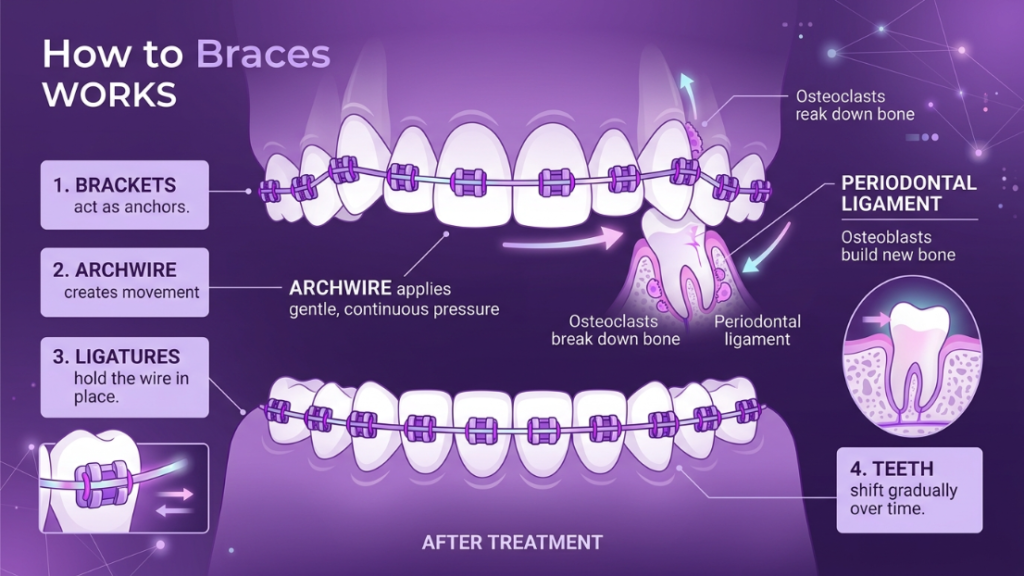
You’ve seen friends and coworkers go through treatment. Maybe you’re considering it yourself. But you’ve never really understood the actual mechanics inside your mouth. How do braces work beyond just “they push teeth around”? Here’s the short answer: Braces apply a constant, gentle force to a tooth. That force triggers your body’s own bone-remodeling cells to dissolve bone on one side of the root and rebuild it on the other. The tooth doesn’t actually move through bone—your body moves the bone around the tooth.
By the end of this page, you’ll understand the biology, the hardware, and why those monthly adjustment appointments are non-negotiable. You’ll never look at an archwire the same way again.
Let’s start with what’s actually happening under your gums.
Science of Tooth Movement: Bone Remodeling Explained
Here’s the counterintuitive truth: your teeth are not fixed directly to your jawbone. A periodontal ligament—a layer of stretchy connective tissue about 0.2mm thick—suspends each tooth in a tiny shock-absorbing hammock.
When an orthodontist places a bracket and threads an archwire, that wire wants to return to its original straight shape. It pushes against the tooth. The tooth pushes against the ligament. The ligament compresses on one side and stretches on the other.
That compression triggers a biological cascade.
How Your Body Moves Bone (The Cellular Level)
Within hours of force application, cells called osteoclasts migrate to the compressed side of the ligament. These are bone-eating cells. They secrete acid and enzymes that dissolve the mineral matrix of your alveolar bone. On the stretched side, osteoblasts—bone-building cells—lay down fresh new bone.
The tooth doesn’t drag through solid bone. Your body clears a path in front and fills the space behind.
This process is called bone remodeling. The American Dental Association (ADA) recognizes it as the fundamental mechanism of all orthodontic tooth movement. Without it, braces would simply crack teeth.
Why Force Must Be Gentle (And Constant)
Too much force crushes the periodontal ligament. Blood supply cuts off. Bone cells die. The tooth stops moving, and you risk root resorption (permanent shortening of the root). Too little force triggers no remodeling at all.
The sweet spot: 10 to 20 grams per square centimeter of root surface. That’s about the weight of two nickels. Your orthodontist achieves this by choosing the right archwire thickness and material.
Braces Mechanics: How Each Component Creates Force
Understanding how braces move teeth means understanding what each piece does. Here’s the breakdown.
Brackets: The Handles
A bracket is a small square bonded directly to each tooth’s enamel. Modern brackets have slots (where the wire sits) and either elastic ligatures (tiny rubber bands) or a self-ligating clip. The bracket transfers force from the wire to the tooth. Without a bracket, the wire would just slide across smooth enamel.
Materials vary:
- Metal brackets (stainless steel): Strongest, most reliable, lowest friction.
- Ceramic brackets (polycrystalline alumina): Tooth-colored, more brittle, higher friction.
- Self-ligating brackets (Damon, others): Built-in sliding clip replaces elastic ligatures. Claims of faster treatment have weak evidence according to the AAO.
Archwires: The Engine
The archwire is the active component. It has memory. When your orthodontist ties a curved wire into straight brackets, the wire wants to straighten. That stored energy becomes the force moving your teeth.
Wires progress through treatment:
- Nickel-titanium (NiTi) wires (first 4–8 months): Extremely flexible, light force. Great for initial leveling.
- Stainless steel wires (months 6–18): Stiffer, heavier force. Used for final detailing and torque control.
- Beta-titanium (intermediate): Somewhere between the two.
Elastics and Rubber Bands: Bite Correction
Brackets and wires move individual teeth. Elastics move whole jaws relative to each other. You hook a small rubber band from a hook on your upper bracket to a hook on your lower bracket. That constant pull corrects overbite, underbite, and crossbite.
Patients wear elastics 20–22 hours per day. Skipping days resets bone remodeling. Most orthodontists say: “The only thing worse than wearing elastics is wearing them longer because you kept forgetting.”
Power Chains: Closing Gaps
A power chain is a connected string of elastic ligatures. It stretches across multiple brackets and pulls them together. Orthodontists use power chains to close extraction spaces or diastema (the gap between front teeth). They also work well for consolidating crowding after initial leveling.
Why Monthly Adjustments Matter
You sit in the chair every 6 to 10 weeks for a reason. Bone remodeling takes time, but it also plateaus.
The Activation Cycle
When your orthodontist places a new archwire or changes elastics, the force starts high. Within a few days, the periodontal ligament adapts. Cells remodel. The tooth moves. Force drops as the wire loses its bend.
By week 8 or 10, force has dropped below the threshold needed to continue remodeling. You hit a plateau. The next adjustment reactivates the system.
Skipping appointments doesn’t just slow treatment. It stops it entirely. Teeth can even drift back toward their original positions (relapse) if left in a passive wire too long.
What Happens During an Adjustment
Your orthodontist or clinical assistant will:
- Remove old elastic ligatures or open self-ligating clips.
- Lift out the existing archwire.
- Assess tooth movement against the treatment plan.
- Select a new wire (often thicker or made of stiffer material).
- Tie the new wire in place.
- Change or add power chains, elastics, or other components.
The whole thing takes 20 to 30 minutes. Soreness peaks 6 to 8 hours later—plan on soft foods that evening.
The American Association of Orthodontists (AAO) states that no bracket system has been proven to move teeth significantly faster than conventional metal braces with elastics. Biology sets the speed limit—not the brand.
What Clear Aligners Do Differently
Invisalign and other clear aligner systems don’t use wires or brackets. Instead, you wear a series of removable plastic trays. Each tray is 0.2–0.3mm different from the last. The principle is the same: gentle force triggers bone remodeling. But the delivery is different.
Aligners apply force through controlled deformation. The plastic grips attachments (tiny tooth-colored bumps bonded to your teeth) and pushes. No archwires. No elastics (though some aligner systems use rubber bands for bite correction).
The tradeoffs:
- Pros: Removable for eating and brushing, nearly invisible, fewer emergency visits.
- Cons: Requires 20–22 hours of wear per day. Compliance is everything. Mild to moderate cases only—complex bites often need braces.
The American Board of Orthodontics (ABO) notes that aligners work well for motivated adults with crowding, spacing, or mild overbite. For severe rotations or vertical bite issues, traditional braces remain the standard.
Questions About How Braces Move Teeth
Do braces hurt because they’re breaking my teeth?
No. The soreness comes from inflammation in the periodontal ligament—the same ligament that makes a loose tooth feel tender. Your teeth are structurally fine. The pain peaks 6–8 hours after an adjustment and fades within 3–5 days.
Why do some people need braces for 36 months?
Complex malocclusion (severe overbite, underbite, or impacted teeth) requires more bone remodeling. Large movements need more time. Also, adult bone is denser than child bone. Adults average 24 months; teens average 18–22 months.
Can braces move teeth too fast?
Yes. Rapid orthodontics (sometimes marketed as “6-month braces”) risks root resorption, gum recession, and relapse. The ADA warns against accelerated claims without peer-reviewed evidence. Safe tooth movement maxes out at about 1–1.5mm per month.
What happens to the bone after braces come off?
Your orthodontist places a retainer. The retention phase allows the periodontal ligament to reorganize and new bone to fully mineralize. Without a retainer, your body’s natural remodeling will slowly move teeth back—a process called relapse. Most patients wear retainers nightly for life.
How Do Braces Work With Other Orthodontic Appliances?
Sometimes braces alone aren’t enough. Your orthodontist might add:
- Palatal expander (children only): Widens the upper jaw by opening the mid-palatal suture. Bone fills in over 3–6 months.
- TADs (temporary anchorage devices) : Mini titanium screws placed in the bone. They act as stationary anchors for elastics or springs. Common in adult cases with missing teeth or severe overbite.
- Headgear (rare in adults): Uses external force from a strap around the head or neck to pull molars back. Adults almost never wear headgear—TADs have replaced it.
- Separators (spacers) : Small rubber or metal rings placed between back molars 1–2 weeks before bonding. They create space for orthodontic bands.
What to Do Next
Now you know the science. How do braces work isn’t magic—it’s biology. Your osteoclasts eat bone. Your osteoblasts build bone. The orthodontist just points them in the right direction.
If you’re considering treatment, your next step is simple: book a consultation with an AAO orthodontist. They’ll take X-rays, examine your periodontal health, and explain exactly how bone remodeling applies to your specific bite.
While you wait for that appointment, read our related guides:
- How to Choose a Board-Certified Orthodontist (ABO Diplomate)
- Braces vs. Clear Aligners: Which Works for Your Case Type?
Frequently Asked Questions
How do braces work to straighten teeth?
Braces apply constant, gentle force to each tooth, triggering osteoclasts to dissolve bone on one side of the root and osteoblasts to rebuild it on the other. The tooth doesn’t move through bone—your body remodels the bone around the tooth.
Do braces work differently for adults vs. children?
The biology is identical. Adult bone is denser and remodels slightly slower, so treatment takes 2–4 months longer on average. Adults also have higher rates of gum recession and root resorption, so orthodontists use lighter forces.
How long does it take for braces to start working?
Bone remodeling begins within 24 hours of placement. You won’t see visible movement for 4–6 weeks, but cellular changes start immediately. The first sign is usually soreness 6–8 hours after the wire goes on.
Can braces work if I have missing teeth?
Yes, but your orthodontist will plan around the missing teeth. Common solutions include closing the space entirely (moving adjacent teeth together), opening space for an implant, or using TADs as anchors to prevent unwanted movement.
Do braces work on teeth that have root canals?
Yes, but with caution. Root canal-treated teeth have no nerve but still have a periodontal ligament. They move normally. However, the tooth is more brittle. Your orthodontist will use lighter forces and monitor with X-rays every 6 months.
Why do braces work faster when I’m younger?
Children and teens have higher baseline bone remodeling activity due to growth hormone. Their osteoclasts and osteoblasts turn over faster. After age 25, bone density increases and remodeling slows. This is why AAO recommends first evaluation at age 7.
Can braces work without extractions?
In about 70% of modern orthodontic cases, yes. Interproximal reduction (shaving 0.2–0.5mm between teeth) creates space without extractions. Severe crowding (over 8mm per arch) or significant overjet usually needs premolar extractions.
How do braces work with elastics to fix an overbite?
Elastics hook from upper front brackets to lower back brackets. The constant pull moves the upper jaw back relative to the lower jaw (or the lower jaw forward). Bone remodeling in the jaw joints and dental sockets gradually corrects the bite over 6–12 months.
Do braces work on impacted teeth?
Yes, but it’s a surgical procedure. An oral surgeon exposes the impacted tooth (usually a canine) and bonds a small gold chain to it. Your orthodontist attaches the chain to the archwire and slowly pulls the tooth into place over 6–12 months.
What happens if braces don’t work as planned?
Mid-treatment problems (slower movement, root resorption, poor compliance with elastics) are common. Your orthodontist will adjust the treatment plan—switching wire types, adding TADs, or extending treatment time. Complete treatment failure is rare (under 2% of cases) when you follow instructions.
Medical Disclaimer: This article is for informational purposes only and is not a substitute for professional dental or orthodontic advice. Always consult a licensed orthodontist for guidance specific to your situation.