
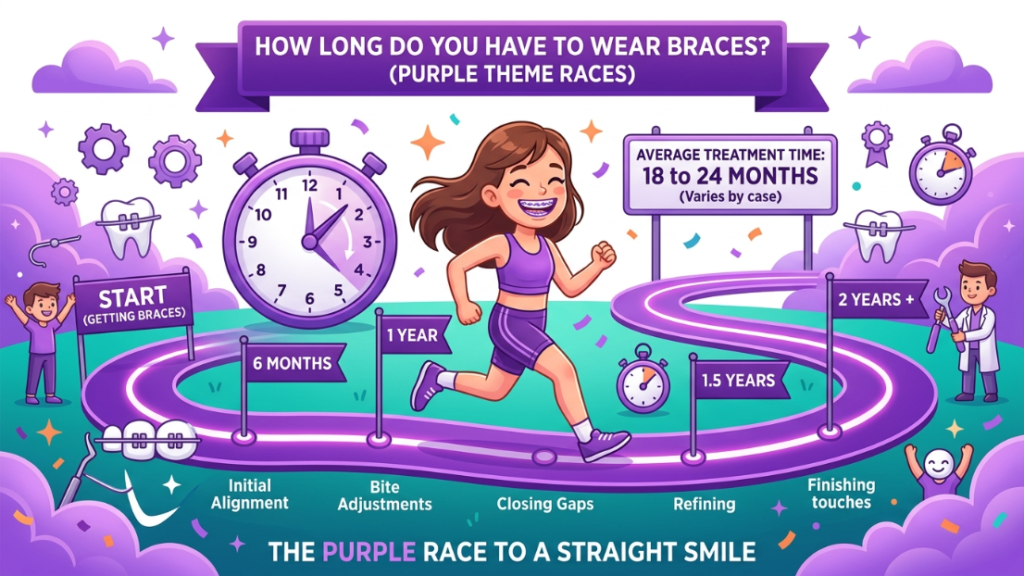
How long do you wear braces? Most patients wear braces for 18 to 24 months. Minor crowding or spacing can finish in as little as 6 months while complex bites with extractions or severe malocclusion may take 36 months or longer. The exact timeline depends on your age, case severity, and how closely you follow your orthodontist’s plan.
You sit in the orthodontist chair for your first visit and the doctor says treatment will take “about two years.” If you are a parent of a teen, an adult finally fixing your bite, or anyone comparing options, you want the real answer to how long do you wear braces. This guide breaks down the average time with braces, what shortens or lengthens treatment, and the practical factors that actually matter. You will finish knowing realistic timelines, what slows progress, and how to set expectations so you stay on track from day one.
Typical Braces Treatment Time
How long do you wear braces depends mostly on the severity of your malocclusion and your age when treatment starts. The American Association of Orthodontists (AAO), the professional body that certifies orthodontic specialists in the US, reports that the majority of patients finish comprehensive Phase 2 treatment in 18 to 24 months. Early Phase 1 interceptive treatment for children ages 7–10 can be much shorter, often 6 to 12 months, and focuses on space creation or jaw development with a palatal expander before full braces.
The retention phase begins the day brackets come off. You wear a custom retainer full time for several months, then nights only for life to prevent teeth from shifting back.
Factors That Shorten Braces Treatment Time
- Mild crowding or spacing with good compliance
- Younger patients whose jaws are still growing
- Consistent rubber band wear and perfect oral hygiene
- No missed appointments or broken appliances
Factors That Extend Braces Treatment Time
Missed appointments push everything back by weeks. Broken brackets or lost elastics require extra visits and slow tooth movement. Poor rubber band compliance is one of the biggest delays—orthodontists see treatment stretch 3 to 6 months longer when patients skip them. Growth spurts in teens can help or hurt depending on timing, and complex cases with extractions or TADs (temporary anchorage devices) naturally take longer.
How Long Do You Wear Braces: Age and Case Details
How long do you wear braces varies by patient group. Children in Phase 1 often finish the first stage in under a year, but full correction still requires Phase 2 later. Teens in full treatment average 18 to 24 months because their jaws respond quickly. Adults usually need 20 to 30 months because bone remodeling slows with age and many cases involve bite correction that takes extra time.
A 14-year-old with mild crowding may finish in 14 months. A 32-year-old with an overbite and several rotations often needs 26 months. Your orthodontist gives a personalized estimate after the initial exam and records.
Braces Treatment Time and Cost
Braces treatment time and cost go hand in hand. Longer cases raise the total because of more adjustments and office visits.
Price Comparison Table
| Brace Type | Average Cost (USD) | Treatment Time | Best For |
| Traditional metal braces | $3,000–$7,000 | 18–24 months | Most malocclusions, budget-friendly |
| Ceramic braces | $4,000–$8,500 | 18–24 months | Aesthetic focus, moderate cases |
| Lingual braces | $8,000–$13,000 | 18–36 months | Adults wanting completely hidden braces |
| Self-ligating braces | $4,000–$8,000 | 12–24 months | Patients wanting fewer adjustments |
| Clear aligners (Invisalign or Spark) | $3,000–$8,000 | 6–18 months | Mild cases, removable convenience |
Cost Breakdown by Age Group
- Children (7–11): $3,000–$5,500. Shorter Phase 1 keeps costs lower.
- Teens (12–17): $3,500–$6,500. Full Phase 2 treatment is the most common.
- Adults (18+): $4,000–$7,000 or higher if TADs or longer timelines apply.
What Drives Price Up or Down
Complex cases with extractions or orthognathic surgery increase costs. Shorter treatments for minor spacing lower them. Location matters—coastal cities run 20–30% higher. Check the state cost index on Brass Smile for your area.
Insurance, HSA/FSA, and Payment Options
Most dental plans cap orthodontic benefits at $1,000–$3,000 lifetime maximum and cover patients under 19 only. You can use HSA or FSA funds tax-free for any braces treatment time.
Without full coverage, discount dental plans, orthodontic schools like NYU or University of Michigan, and in-house payment plans help. Expect 20–30% down and $100–$300 monthly over 18–36 months. CareCredit offers common 0% interest options.
Hidden Costs to Budget For
Retainers cost $150–$600 after treatment. Emergency visits for broken brackets run $50–$150. Lost elastics or extra adjustments add up if compliance slips.
What Slows Braces Treatment Time
How long do you wear braces stretches when you miss appointments, break brackets, or skip rubber bands. Non-compliance with elastics is the top reason orthodontists see treatment run 3 to 6 months longer than planned. Broken appliances require repair visits that pause progress. Poor hygiene leads to cavities or white spots that delay bracket changes.
You control most of these factors. Show up on time, wear elastics as directed, and keep your teeth clean to stay on schedule.
About BrassSmile
BrassSmile launched in 2023 after founder Alex Rivera spent two years guiding her own children through orthodontic treatment. She saw the need for honest, independent information that cuts through marketing hype and affiliate blogs.
Editorial Team
- Alex Rivera, Founder & Lead Writer (LinkedIn)
- Dr. Lisa Chen, DMD, ABO diplomate, Medical Reviewer (LinkedIn)
- Jordan Patel, DDS, Content Editor
Every article receives review by a board-certified orthodontist before publication. We update this page every six months or sooner when AAO or ADA guidelines change. We cite only peer-reviewed sources and official data from the American Dental Association (ADA), American Association of Orthodontists (AAO), and CDC dental health statistics.
Frequently Asked Questions
How long do you wear braces on average?
Most people wear braces for 18 to 24 months on average. Minor cases finish faster while complex bites take longer.
What is the shortest braces treatment time?
The shortest braces treatment time is about 6 months for very mild crowding or spacing with excellent compliance.
How long do you wear braces if you miss appointments?
Missed appointments extend how long do you wear braces by weeks or months because progress pauses until the next visit.
Does rubber band non-compliance affect braces treatment time?
Rubber band non-compliance lengthens braces treatment time by 3 to 6 months in many cases because teeth stop moving as planned.
How long do you wear braces as an adult?
Adults usually wear braces 20 to 30 months because bone remodeling takes longer than in growing teens.
Can braces treatment time be shortened?
Braces treatment time can be shortened with perfect compliance, good hygiene, and showing up for every appointment on schedule.
What is the longest typical braces treatment time?
The longest typical braces treatment time reaches 36 months or more for severe malocclusion that needs extractions or surgery.
Do clear aligners change how long do you wear braces?
Clear aligners often finish mild cases in 6 to 18 months, but they still require 22 hours daily wear to stay on schedule.
How long do you wear retainers after braces?
You wear retainers full time for several months after braces, then nights only for life to keep teeth straight.
Does age affect average time with braces?
Age affects average time with braces—teens usually finish faster than adults because their jaws and bone respond more quickly to movement.